Building an MCP Server in Go from scratch
Introduction
The Model Context Protocol (MCP) is an open standard that defines how AI applications (like Claude) communicate with external tools and data sources. Think of it as a USB port for AI: a universal interface that lets any compliant client talk to any compliant server.
In this article, we’ll build an MCP server in Go from scratch – no third-party MCP libraries, just the standard library and the MCP specification. By the end, you’ll understand how the protocol works at the wire level and have a working server with three example tools.
What is MCP?
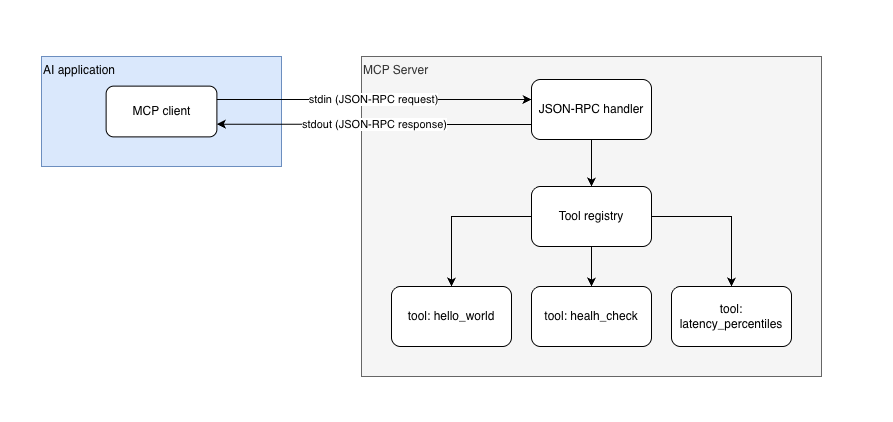
MCP follows a client-server architecture where:
- MCP Clients are AI applications (Claude Desktop, Claude Code, IDE extensions) that need to access external capabilities.
- MCP Servers expose those capabilities as tools – functions that the AI can discover and invoke.
The transport layer is JSON-RPC 2.0 over stdio (standard input/output). The client spawns the server as a child process, sends JSON-RPC requests to its stdin, and reads JSON-RPC responses from its stdout.
JSON-RPC 2.0: the transport layer
Before diving into MCP specifics, let’s understand the transport. JSON-RPC 2.0 defines two types of messages:
Requests have an id and expect a response:
{"jsonrpc": "2.0", "id": 1, "method": "ping"}
Notifications have no id and expect no response:
{"jsonrpc": "2.0", "method": "notifications/initialized"}
Responses echo back the request id and carry either a result or an error:
{"jsonrpc": "2.0", "id": 1, "result": {}}
Error codes are standardized by the JSON-RPC spec:
| Code | Meaning |
|---|---|
| -32700 | Parse error |
| -32600 | Invalid request |
| -32601 | Method not found |
| -32602 | Invalid params |
| -32603 | Internal error |
Since the transport is stdio, each JSON-RPC message must be a single line – no pretty-printing, no line breaks within a message.
The MCP initialization handshake
Before a client can use any tools, it must complete a handshake:
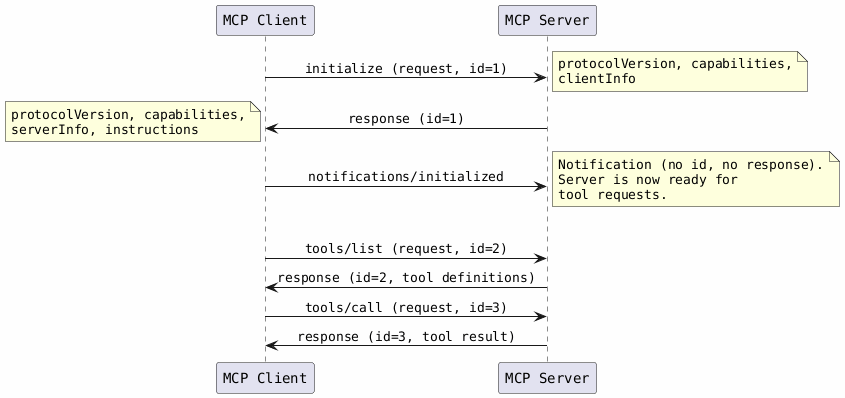
- The client sends an
initializerequest with its protocol version and capabilities. - The server responds with its own protocol version, capabilities, and instructions.
- The client sends a
notifications/initializednotification (noid, no response expected). - Only after step 3 does the server accept
tools/listandtools/callrequests.
This handshake ensures both sides agree on the protocol version and know each other’s capabilities before any work begins.
Project structure
go-mcp-server/
├── cmd/
│   └── main.go            # Entry point, signal handling, graceful shutdown
├── jsonrpc/
│   └── jsonrpc.go          # JSON-RPC 2.0 types and error codes
├── server/
│   ├── server.go           # MCP server: request routing, handlers, tool registry
│   └── server_test.go      # Integration tests
├── tools/
│   ├── hello.go            # hello_world tool
│   ├── health.go           # health_check tool
│   ├── percentiles.go      # latency_percentiles tool
│   ├── http.go             # HTTP abstractions (for testability)
│   └── tools.go            # Tool registration (wires definitions to handlers)
├── Makefile
├── go.mod
└── go.sum
Implementation
JSON-RPC types
We start with the wire format. The jsonrpc package defines the request, response, and error types that map directly to the JSON-RPC 2.0 spec:
// jsonrpc/jsonrpc.go

package jsonrpc

import "encoding/json"

// Request represents a JSON-RPC request object.
type Request struct {
	JSONRPC string          `json:"jsonrpc"`
	ID      any             `json:"id,omitempty"`
	Method  string          `json:"method"`
	Params  json.RawMessage `json:"params,omitempty"`
}

// Response represents a JSON-RPC response object.
type Response struct {
	JSONRPC string `json:"jsonrpc"`
	ID      any    `json:"id,omitempty"`
	Result  any    `json:"result,omitempty"`
	Error   *Error `json:"error,omitempty"`
}

// Error represents a JSON-RPC error object.
type Error struct {
	Code    int    `json:"code"`
	Message string `json:"message"`
	Data    any    `json:"data,omitempty"`
}

// Predefined error codes for JSON-RPC 2.0.
// https://www.jsonrpc.org/specification#error_object
const (
	ParseError     = -32700
	InvalidRequest = -32600
	MethodNotFound = -32601
	InvalidParams  = -32602
	InternalError  = -32603
)
A few things to note:
IDisanybecause JSON-RPC allows string or numeric IDs, and notifications have no ID at all (omitemptyhandles that).Paramsisjson.RawMessageso we can defer parsing until we know which method was called.- The error codes are defined by the JSON-RPC 2.0 specification, not MCP. MCP inherits them since it uses JSON-RPC as its transport.
The server
The server package is the heart of the project. Let’s walk through it in sections.
Types and constructor
// server/server.go

const ProtocolVersion = "2025-06-18"

// ToolDefinition defines a tool that can be called by the client.
type ToolDefinition struct {
	Name        string         `json:"name"`
	Description string         `json:"description,omitempty"`
	InputSchema map[string]any `json:"inputSchema"`
}

// ToolHandler is a function that implements the logic of a tool.
type ToolHandler func(ctx context.Context, arguments json.RawMessage) (any, error)

// Server implements the MCP protocol over JSON-RPC 2.0.
type Server struct {
	in  io.Reader
	out io.Writer

	mu          sync.RWMutex
	tools       map[string]ToolHandler
	definitions map[string]ToolDefinition
	initialized bool
	handlers    map[string]func(context.Context, jsonrpc.Request) error
	logger      *slog.Logger
}
The server reads from in and writes to out. In production these are os.Stdin and os.Stdout, but accepting io.Reader/io.Writer makes the server fully testable without real I/O.
The constructor wires up the method dispatch table:
func New(in io.Reader, out io.Writer, logger *slog.Logger) *Server {
	s := &Server{
		in:          in,
		out:         out,
		tools:       make(map[string]ToolHandler),
		definitions: make(map[string]ToolDefinition),
		logger:      logger,
	}

	s.handlers = map[string]func(context.Context, jsonrpc.Request) error{
		"initialize":                s.handleInitialize,
		"notifications/initialized": s.handleInitializedNotification,
		"ping":                      s.handlePing,
		"tools/list":                s.handleToolsList,
		"tools/call":                s.handleToolsCall,
	}

	return s
}
Tool registration
Tools can be registered at any time before or after initialization:
func (s *Server) RegisterTool(def ToolDefinition, handler ToolHandler) {
	s.mu.Lock()
	defer s.mu.Unlock()

	s.definitions[def.Name] = def
	s.tools[def.Name] = handler
}
The main loop
The Run method reads JSON-RPC messages line by line. Since bufio.Scanner.Scan() is a blocking call that doesn’t respect context cancellation, we push it into a goroutine and use channels so the main loop can select on both incoming lines and ctx.Done():
func (s *Server) Run(ctx context.Context) error {
	s.logger.Info("mcp server started", slog.String("protocolVersion", ProtocolVersion))
	defer s.logger.Info("mcp server stopped")

	scanner := bufio.NewScanner(s.in)
	scanner.Buffer(make([]byte, 0, 64*1024), 1024*1024)

	// scanCh delivers lines from stdin so we can select on ctx.Done().
	scanCh := make(chan []byte)
	scanErr := make(chan error, 1)
	go func() {
		defer close(scanCh)
		for scanner.Scan() {
			line := make([]byte, len(scanner.Bytes()))
			copy(line, scanner.Bytes())
			scanCh <- line
		}
		scanErr <- scanner.Err()
	}()

	for {
		var line []byte
		select {
		case <-ctx.Done():
			return ctx.Err()
		case l, ok := <-scanCh:
			if !ok {
				if err := <-scanErr; err != nil {
					return fmt.Errorf("reading input: %w", err)
				}
				return nil
			}
			line = l
		}

		if len(line) == 0 {
			continue
		}

		// ... parse JSON, validate version, dispatch to handler
	}
}
Without the goroutine + channel approach, a Ctrl+C signal would cancel the context, but the loop would remain blocked on scanner.Scan() until new input arrived – making the server unable to shut down cleanly.
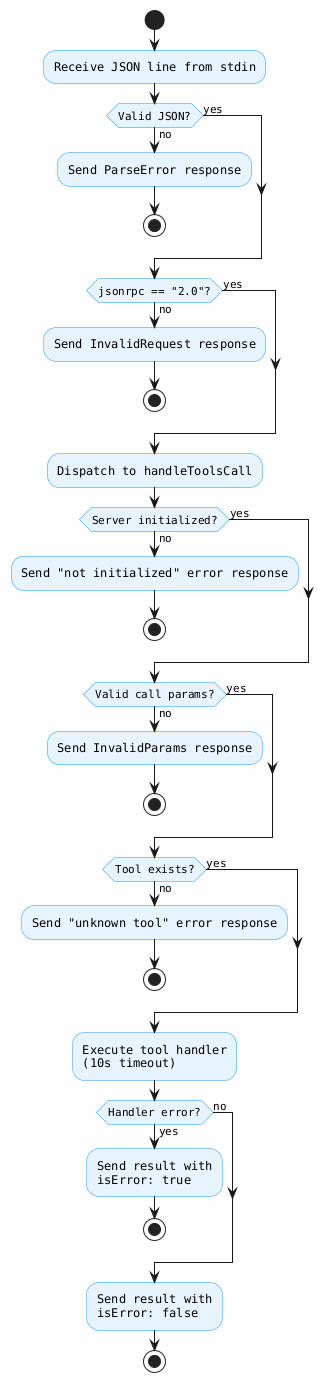
Each incoming line goes through three stages:
- Parse: unmarshal JSON. If it fails, send a
ParseErrorresponse. - Validate: check that
jsonrpcis"2.0". If not, send anInvalidRequestresponse. - Dispatch: route to the appropriate handler based on the
methodfield.
The dispatch also handles the errNotInitialized sentinel: when a request arrives before the handshake is complete, the error response has already been written to the client – we just continue to the next message instead of killing the server:
if err := s.handleRequest(ctx, req); err != nil {
    if errors.Is(err, errNotInitialized) {
        continue
    }
    return errors.WithMessage(err, "failed to handle request")
}
Request dispatch
func (s *Server) handleRequest(ctx context.Context, req jsonrpc.Request) error {
	handler, ok := s.handlers[req.Method]
	if ok {
		return handler(ctx, req)
	}

	// Unknown notification (no ID) -- silently ignore per the spec.
	if req.ID == nil {
		s.logger.Debug("ignoring unknown notification", slog.String("method", req.Method))
		return nil
	}

	// Unknown method with an ID -- respond with MethodNotFound.
	return s.writeResponse(jsonrpc.Response{
		JSONRPC: "2.0",
		ID:      req.ID,
		Error: &jsonrpc.Error{
			Code:    jsonrpc.MethodNotFound,
			Message: fmt.Sprintf("method not found: %s", req.Method),
		},
	})
}
Per the JSON-RPC spec, unknown notifications (no id) are silently ignored, while unknown requests (with an id) get a MethodNotFound error response.
Initialization handlers
The initialize handler responds with the server’s protocol version, capabilities, and instructions:
func (s *Server) handleInitialize(ctx context.Context, req jsonrpc.Request) error {
s.logger.Info("initialize request received", slog.Any("id", req.ID))
type initializeParams struct {
ProtocolVersion string `json:"protocolVersion"`
Capabilities map[string]any `json:"capabilities"`
ClientInfo map[string]any `json:"clientInfo"`
}
var params initializeParams
if len(req.Params) > 0 {
if err := json.Unmarshal(req.Params, ¶ms); err != nil {
return s.writeResponse(jsonrpc.Response{
JSONRPC: "2.0",
ID: req.ID,
Error: &jsonrpc.Error{
Code: jsonrpc.InvalidParams,
Message: fmt.Sprintf("invalid initialize params: %v", err),
},
})
}
}
return s.writeResponse(jsonrpc.Response{
JSONRPC: "2.0",
ID: req.ID,
Result: map[string]any{
"protocolVersion": ProtocolVersion,
"capabilities": map[string]any{
"tools": map[string]any{
"listChanged": false,
},
},
"serverInfo": map[string]any{
"name": "go-mcp-server",
"version": "0.1.0",
},
"instructions": "This educational MCP server provides hello_world, health_check, and latency_percentiles tools.",
},
})
}
The notifications/initialized handler flips the initialized flag:
func (s *Server) handleInitializedNotification(ctx context.Context, req jsonrpc.Request) error {
	s.mu.Lock()
	s.initialized = true
	s.mu.Unlock()
	s.logger.Info("initialized notification received")
	return nil
}
The initialization guard
Any handler that requires initialization calls requireInitialized first. If the server hasn’t been initialized, it writes an error response to the client and returns a sentinel error:
var errNotInitialized = errors.New("server not initialized")

func (s *Server) requireInitialized(req jsonrpc.Request) error {
	s.mu.RLock()
	initialized := s.initialized
	s.mu.RUnlock()

	if initialized {
		return nil
	}

	if err := s.writeResponse(jsonrpc.Response{
		JSONRPC: "2.0",
		ID:      req.ID,
		Error: &jsonrpc.Error{
			Code:    jsonrpc.InvalidRequest,
			Message: "server has not received notifications/initialized yet",
		},
	}); err != nil {
		return err
	}

	return errNotInitialized
}
Returning errNotInitialized instead of nil is critical. Without the sentinel, the callers would check if err != nil, see nil, and fall through to execute the handler anyway – sending a second response for the same request.
Tool listing
handleToolsList returns all registered tools sorted alphabetically:
func (s *Server) handleToolsList(ctx context.Context, req jsonrpc.Request) error {
	if err := s.requireInitialized(req); err != nil {
		return err
	}

	s.mu.RLock()
	defer s.mu.RUnlock()

	defs := make([]ToolDefinition, 0, len(s.definitions))
	for _, def := range s.definitions {
		defs = append(defs, def)
	}

	sort.Slice(defs, func(i, j int) bool {
		return defs[i].Name < defs[j].Name
	})

	return s.writeResponse(jsonrpc.Response{
		JSONRPC: "2.0",
		ID:      req.ID,
		Result: map[string]any{
			"tools": defs,
		},
	})
}
Tool invocation
handleToolsCall looks up the tool by name, runs it with a 10-second timeout, and returns either the result or an error:
func (s *Server) handleToolsCall(ctx context.Context, req jsonrpc.Request) error {
if err := s.requireInitialized(req); err != nil {
return err
}
type callParams struct {
Name string `json:"name"`
Arguments json.RawMessage `json:"arguments"`
}
var params callParams
if err := json.Unmarshal(req.Params, ¶ms); err != nil {
return s.writeResponse(jsonrpc.Response{
JSONRPC: "2.0",
ID: req.ID,
Error: &jsonrpc.Error{
Code: jsonrpc.InvalidParams,
Message: fmt.Sprintf("invalid tools/call params: %v", err),
},
})
}
s.mu.RLock()
handler, ok := s.tools[params.Name]
s.mu.RUnlock()
if !ok {
return s.writeResponse(jsonrpc.Response{
JSONRPC: "2.0",
ID: req.ID,
Error: &jsonrpc.Error{
Code: jsonrpc.InvalidParams,
Message: fmt.Sprintf("unknown tool: %s", params.Name),
},
})
}
callCtx, cancel := context.WithTimeout(ctx, 10*time.Second)
defer cancel()
result, err := handler(callCtx, params.Arguments)
if err != nil {
return s.writeResponse(jsonrpc.Response{
JSONRPC: "2.0",
ID: req.ID,
Result: map[string]any{
"content": []map[string]any{
{"type": "text", "text": err.Error()},
},
"isError": true,
},
})
}
pretty, err := json.MarshalIndent(result, "", " ")
if err != nil {
return errors.WithMessage(err, "failed to indent json response")
}
return s.writeResponse(jsonrpc.Response{
JSONRPC: "2.0",
ID: req.ID,
Result: map[string]any{
"content": []map[string]any{
{"type": "text", "text": string(pretty)},
},
"structuredContent": result,
"isError": false,
},
})
}
Note that tool errors are not JSON-RPC errors. Per the MCP spec, a tool that fails returns a successful JSON-RPC response with isError: true in the result. JSON-RPC errors are reserved for protocol-level problems (bad params, unknown method, etc.).
The following diagram illustrates the full request flow for a tools/call:
The tools
Each tool is a plain Go function. The tools package defines three examples.
hello_world
A simple greeter:
// tools/hello.go

type HelloArgs struct {
	Name string `json:"name"`
}

type HelloResult struct {
	Message string `json:"message"`
}

func Hello(args HelloArgs) (HelloResult, error) {
	name := strings.TrimSpace(args.Name)
	if name == "" {
		name = "world"
	}

	return HelloResult{
		Message: fmt.Sprintf("Hello, %s", name),
	}, nil
}
health_check
Performs an HTTP GET and returns the status code and latency:
// tools/health.go

type HealthCheckArgs struct {
	URL       string `json:"url"`
	TimeoutMS int    `json:"timeout_ms,omitempty"`
}

type HealthCheckResult struct {
	URL        string `json:"url"`
	StatusCode int    `json:"status_code"`
	LatencyMS  int64  `json:"latency_ms"`
	OK         bool   `json:"ok"`
}

func HealthCheck(ctx context.Context, args HealthCheckArgs) (HealthCheckResult, error) {
	if args.URL == "" {
		return HealthCheckResult{}, errors.New("url is required")
	}

	timeout := 3 * time.Second
	if args.TimeoutMS > 0 {
		timeout = time.Duration(args.TimeoutMS) * time.Millisecond
	}

	client := newHTTPClient(timeout)

	req, err := requestBuilderProvider.NewRequestWithContext(ctx, http.MethodGet, args.URL, nil)
	if err != nil {
		return HealthCheckResult{}, errors.WithMessage(err, "failed to create request")
	}

	start := time.Now()
	resp, err := client.Do(req)
	if err != nil {
		return HealthCheckResult{}, errors.WithMessage(err, "failed to perform request")
	}
	defer func() {
		io.Copy(io.Discard, resp.Body)
		resp.Body.Close()
	}()

	latency := time.Since(start).Milliseconds()

	return HealthCheckResult{
		URL:        args.URL,
		StatusCode: resp.StatusCode,
		LatencyMS:  latency,
		OK:         resp.StatusCode >= 200 && resp.StatusCode < 300,
	}, nil
}
Notice that we drain the response body before closing it. This ensures the underlying TCP connection can be reused by the HTTP client’s connection pool. Calling resp.Body.Close() alone doesn’t guarantee connection reuse if the body wasn’t fully read.
The HTTP client and request builder are abstracted behind interfaces for testability:
// tools/http.go

type requestBuilder interface {
	NewRequestWithContext(ctx context.Context, method string, url string, body io.Reader) (*http.Request, error)
}

var requestBuilderProvider requestBuilder = &defaultRequestBuilderProvider{}

type httpClient interface {
	Do(req *http.Request) (*http.Response, error)
}

type httpClientFactory func(timeout time.Duration) httpClient

var newHTTPClient httpClientFactory = func(timeout time.Duration) httpClient {
	return &http.Client{Timeout: timeout}
}
The factory pattern for httpClient lets us inject different timeouts per request while still being mockable in tests.
latency_percentiles
Computes statistical percentiles for a list of numeric values:
// tools/percentiles.go

type PercentilesArgs struct {
	Values []float64 `json:"values"`
}

type PercentilesResult struct {
	Count int     `json:"count"`
	Min   float64 `json:"min"`
	P50   float64 `json:"p50"`
	P95   float64 `json:"p95"`
	P99   float64 `json:"p99"`
	Max   float64 `json:"max"`
	Avg   float64 `json:"avg"`
}

func Percentiles(args PercentilesArgs) (PercentilesResult, error) {
	if len(args.Values) == 0 {
		return PercentilesResult{}, errors.New("values must not be empty")
	}

	values := make([]float64, len(args.Values))
	copy(values, args.Values)
	sort.Float64s(values)

	var sum float64
	for _, v := range values {
		sum += v
	}

	return PercentilesResult{
		Count: len(values),
		Min:   values[0],
		P50:   percentile(values, 50),
		P95:   percentile(values, 95),
		P99:   percentile(values, 99),
		Max:   values[len(values)-1],
		Avg:   sum / float64(len(values)),
	}, nil
}
Note that we copy the input slice before sorting to avoid mutating the caller’s data.
Wiring it all together
The RegisterDefaultTools function connects tool definitions (name, description, input schema) to their handlers:
// tools/tools.go

func RegisterDefaultTools(s *server.Server) {
	s.RegisterTool(
		server.ToolDefinition{
			Name:        "hello_world",
			Description: "Generate a greeting message for a given name. Use this when the user asks to greet someone, say hello, or produce a simple greeting.",
			InputSchema: map[string]any{
				"type": "object",
				"properties": map[string]any{
					"name": map[string]any{
						"type":        "string",
						"description": "Optional name to greet.",
					},
				},
			},
		},
		func(ctx context.Context, raw json.RawMessage) (any, error) {
			var args HelloArgs
			if len(raw) > 0 {
				if err := json.Unmarshal(raw, &args); err != nil {
					return nil, fmt.Errorf("decoding arguments: %w", err)
				}
			}
			return Hello(args)
		},
	)

	// ... health_check and latency_percentiles follow the same pattern
}
The InputSchema follows JSON Schema format, which is how MCP clients know what arguments each tool expects.
Entry point and graceful shutdown
// cmd/main.go

func run(ctx context.Context, logger *slog.Logger) error {
	mcpServer := server.New(os.Stdin, os.Stdout, logger)
	tools.RegisterDefaultTools(mcpServer)

	shutdown := make(chan os.Signal, 1)
	signal.Notify(shutdown, os.Interrupt, syscall.SIGTERM)

	ctx, cancel := context.WithCancel(ctx)
	defer cancel()

	serverErrors := make(chan error, 1)

	go func() {
		serverErrors <- mcpServer.Run(ctx)
	}()

	select {
	case err := <-serverErrors:
		return errors.WithMessage(err, "MCP server error")
	case sig := <-shutdown:
		logger.Info("shutdown signal received", slog.String("signal", sig.String()))
		cancel()
		return nil
	}
}
The select between serverErrors and shutdown is key. Without it, a Ctrl+C signal would be captured by the channel but never read, making the server unable to stop.
Testing it manually
Start the server:
make run
This runs cat | go run cmd/main.go, keeping stdin open so you can type messages interactively.
Step 1: Initialize
Paste this line and press Enter:
{"jsonrpc":"2.0","id":1,"method":"initialize","params":{"protocolVersion":"2025-06-18","capabilities":{},"clientInfo":{"name":"manual-test","version":"0.1.0"}}}
You’ll get back the server capabilities.
Step 2: Confirm initialization
{"jsonrpc":"2.0","method":"notifications/initialized"}
No response (it’s a notification).
Step 3: List tools
{"jsonrpc":"2.0","id":2,"method":"tools/list"}
Step 4: Call a tool
{"jsonrpc":"2.0","id":3,"method":"tools/call","params":{"name":"hello_world","arguments":{"name":"Tiago"}}}
{"jsonrpc":"2.0","id":4,"method":"tools/call","params":{"name":"health_check","arguments":{"url":"https://httpbin.org/get","timeout_ms":5000}}}
{"jsonrpc":"2.0","id":5,"method":"tools/call","params":{"name":"latency_percentiles","arguments":{"values":[12.5,45.3,67.8,23.1,89.4,34.6,56.7,78.9,11.2,99.0]}}}
Remember: each message must be on a single line. The server reads input line by line with bufio.Scanner, so a line break in the middle of a JSON message will cause a parse error.
Press Ctrl+C to stop the server.
Integration tests
Since the server accepts io.Reader/io.Writer, we can test the full request/response flow without real stdio. We feed JSON-RPC messages through a strings.Reader and capture output in a bytes.Buffer:
// server/server_test.go

func TestRun_ToolsCall_Success(t *testing.T) {
	input := initHandshake() +
		`{"jsonrpc":"2.0","id":3,"method":"tools/call","params":{"name":"echo","arguments":{"msg":"hi"}}}` + "\n"
	out := &bytes.Buffer{}
	s := New(strings.NewReader(input), out, discardLogger())
	registerEchoTool(s)

	err := s.Run(context.Background())
	require.NoError(t, err)

	responses := parseResponses(t, out)
	require.Len(t, responses, 2) // initialize + tools/call

	callResp := responses[1]
	require.Nil(t, callResp.Error)
	require.Equal(t, float64(3), callResp.ID)

	result := resultMap(t, callResp)
	require.Equal(t, false, result["isError"])
}
For error paths, we use custom io.Writer and io.Reader implementations:
// errWriter always returns an error on Write.
type errWriter struct{}

func (w *errWriter) Write(p []byte) (int, error) {
	return 0, errors.New("write error")
}

func TestRun_WriteError_ParseError(t *testing.T) {
	input := "not json\n"
	s := New(strings.NewReader(input), &errWriter{}, discardLogger())

	err := s.Run(context.Background())
	require.Error(t, err)
	require.Contains(t, err.Error(), "failed to unmarshal request")
}
For context cancellation, we use io.Pipe so the scanner blocks waiting for input, then cancel the context from a goroutine:
func TestRun_ContextCanceled(t *testing.T) {
	r, w := io.Pipe()
	defer w.Close()
	out := &bytes.Buffer{}
	ctx, cancel := context.WithCancel(context.Background())

	s := New(r, out, discardLogger())

	done := make(chan error, 1)
	go func() {
		done <- s.Run(ctx)
	}()

	cancel()

	err := <-done
	require.ErrorIs(t, err, context.Canceled)
}
Running the tests
make test
For coverage:
make coverage
Conclusion
We’ve built a working MCP server from scratch in Go, covering:
- JSON-RPC 2.0 as the wire protocol
- MCP initialization handshake (initialize -> initialized notification -> ready)
- Tool registration and invocation with JSON Schema input definitions
- Graceful shutdown with signal handling and context cancellation
- Integration tests that achieve 99%+ coverage by testing through the public stdio interface
The full source code is available on GitHub.