Real-Time Flight Tracking in Go with Redis and JSON Streaming

In my previous article, “Efficient JSON Streaming in a REST API”, I demonstrated how a client can efficiently stream JSON data to a server, reducing memory overhead for large payloads.
In this article, we’re flipping the scenario—this time, the server is the one streaming data to the client. We’ll build a real-time flight tracking service in Go, using:
- The OpenSky API for live flight data.
- Redis Pub/Sub for real-time message distribution.
- Chunked HTTP responses to stream JSON objects as they arrive.
This approach enables clients to receive continuous flight updates without polling, making it ideal for real-time applications.
Understanding JSON streaming
JSON Streaming is a technique for handling large datasets incrementally, instead of loading an entire JSON document at once.
In traditional APIs:
- A client makes a request.
- The server processes everything.
- The entire JSON response is sent only after processing completes.
With streaming, the server sends partial JSON objects as soon as they are available. This reduces memory usage and improves performance for real-time applications.
Why real-time streaming?
Polling APIs for frequent updates is inefficient. Instead:
- We use Redis Pub/Sub to distribute flight status updates.
- Clients receive new data instantly when a message is published.
- JSON is streamed in chunks over an open HTTP connection.
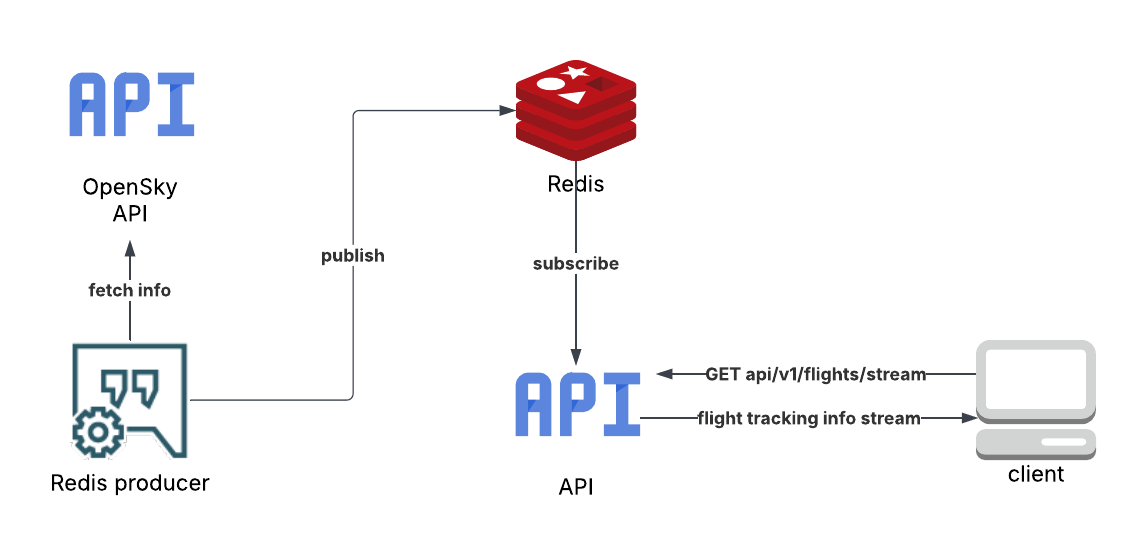
How it works
- The Redis publisher fetches live flight data from the OpenSky API.
- The publisher pushes the data to a Redis Pub/Sub topic.
- The API subscribes to Redis and streams new flight updates as they arrive.
- Clients remain connected to receive real-time updates.
Building the Redis publisher
Our Redis Publisher fetches flight data and publishes it in JSON format to a Redis Pub/Sub channel.
Publisher Code
// Copyright (c) 2025 Tiago Melo. All rights reserved.
// Use of this source code is governed by the MIT License that can be found in
// the LICENSE file.

package main

import (
	"context"
	"fmt"
	"log/slog"
	"os"
	"os/signal"
	"syscall"
	"time"

	"github.com/pkg/errors"
	"github.com/tiagomelo/go-flight-tracker-service/config"
	"github.com/tiagomelo/go-flight-tracker-service/opensky"
	"github.com/tiagomelo/go-flight-tracker-service/redis"
)

func run(log *slog.Logger) error {
	ctx := context.Background()
	defer log.InfoContext(ctx, "completed")

	log.InfoContext(ctx, "initializing redis-publisher")

	// =========================================================================
	// configuration Reading.

	cfg, err := config.Read()
	if err != nil {
		return errors.Wrap(err, "reading configuration")
	}

	// =========================================================================
	// Redis Client.

	redisClient := redis.NewClient(cfg.RedisAddress, cfg.RedisPassword, cfg.RedisDb)
	defer redisClient.Close()

	// =========================================================================
	// OpenSky Client.

	openSkyClient := opensky.NewClient(cfg.OpenSkyUsername, cfg.OpenSkyPassword, time.Duration(cfg.OpenSkyHttpTimeoutInSeconds)*time.Second)

	// channel to listen for OS shutdown signals.
	shutdown := make(chan os.Signal, 1)
	signal.Notify(shutdown, os.Interrupt, syscall.SIGTERM)

	// channel for errors.
	fetchingErrors := make(chan error, 1)
	redisPublishingErrors := make(chan error, 1)

	// start OpenSky fetching in a loop.
	go func() {
		ticker := time.NewTicker(time.Duration(cfg.RedisPublishIntervalInSeconds) * time.Second)
		defer ticker.Stop()

		for {
			select {
			case <-shutdown:
				log.InfoContext(ctx, "Shutdown signal received. Stopping publisher.")
				return
			case <-ticker.C:
				log.InfoContext(ctx, "publishing data")
				data, err := openSkyClient.AllStatesWithinBrazil(ctx)
				if err != nil {
					fetchingErrors <- err
					return
				}
				err = redisClient.Publish(ctx, cfg.RedisTopic, data)
				if err != nil {
					redisPublishingErrors <- err
					return
				}
			}
		}
	}()

	// blocking main waiting for shutdown or errors.
	select {
	case err := <-fetchingErrors:
		return errors.Wrap(err, "fetching error")
	case err := <-redisPublishingErrors:
		return errors.Wrap(err, "publishing error")
	case sig := <-shutdown:
		log.InfoContext(ctx, fmt.Sprintf("Starting shutdown: %v", sig))
		if err := redisClient.Close(); err != nil {
			return err
		}
	}

	return nil
}

func main() {
	log := slog.New(slog.NewJSONHandler(os.Stdout, nil))
	if err := run(log); err != nil {
		log.Error("error", slog.Any("err", err))
		os.Exit(1)
	}
}
This publishes flight data every few seconds.
Implementing the streaming API
Our API subscribes to Redis and streams data as it arrives.
Streaming response handler
// Copyright (c) 2025 Tiago Melo. All rights reserved.
// Use of this source code is governed by the MIT License that can be found in
// the LICENSE file.

package flights

import (
	"context"
	"encoding/json"
	"log"
	"log/slog"
	"net/http"

	redisV9 "github.com/redis/go-redis/v9"
	"github.com/tiagomelo/go-flight-tracker-service/cast"
	"github.com/tiagomelo/go-flight-tracker-service/redis"
)

// redisPubSub is an interface that abstracts the redis.PubSub type.
type redisPubSub interface {
	Channel(opts ...redisV9.ChannelOption) <-chan *redisV9.Message
	Close() error
}

// for ease of unit testing.
var (
	jsonUnmarshal  = json.Unmarshal
	redisSubscribe = func(ctx context.Context, redisClient *redis.Client, channel string) redisPubSub {
		return redisClient.Subscribe(ctx, channel)
	}
)

// handlers is a collection of HTTP handlers for the flights service.
type handlers struct {
	redisClient *redis.Client
	redisTopic  string
	log         *slog.Logger
}

// NewHandlers returns a new handlers instance.
func NewHandlers(redisClient *redis.Client, redisTopic string, log *slog.Logger) *handlers {
	return &handlers{
		redisClient: redisClient,
		redisTopic:  redisTopic,
		log:         log,
	}
}

// FlightStatus represents the status of a flight.
type FlightStatus struct {
	Icao24       string  `json:"icao24"`
	Callsign     string  `json:"callsign"`
	TimePosition int     `json:"time_position"`
	Longitude    float64 `json:"longitude"`
	Latitude     float64 `json:"latitude"`
	BaroAltitude float64 `json:"baro_altitude"`
	OnGround     bool    `json:"on_ground"`
	Velocity     float64 `json:"velocity"`
	TrueTrack    float64 `json:"true_track"`
	VerticalRate float64 `json:"vertical_rate"`
}

// HandleStream handles the /v1/flights/stream endpoint.
func (h *handlers) HandleStream(w http.ResponseWriter, r *http.Request) {
	pubsub := redisSubscribe(r.Context(), h.redisClient, h.redisTopic)
	defer pubsub.Close()
	ch := pubsub.Channel()
	w.Header().Set("Content-Type", "application/json")
	w.Header().Set("Transfer-Encoding", "chunked")
	for msg := range ch {
		var response struct {
			Time   int64           `json:"time"`
			States [][]interface{} `json:"states"`
		}
		if err := jsonUnmarshal([]byte(msg.Payload), &response); err != nil {
			log.Println("Error decoding JSON:", err)
			continue
		}
		for _, state := range response.States {
			if len(state) < 11 {
				continue
			}
			flight := FlightStatus{
				Icao24:       cast.SafeCast(state[0], ""),
				Callsign:     cast.SafeCast(state[1], ""),
				TimePosition: cast.SafeCast(state[3], 0),
				Longitude:    cast.SafeCast(state[5], 0.0),
				Latitude:     cast.SafeCast(state[6], 0.0),
				BaroAltitude: cast.SafeCast(state[7], 0.0),
				OnGround:     cast.SafeCast(state[8], false),
				Velocity:     cast.SafeCast(state[9], 0.0),
				TrueTrack:    cast.SafeCast(state[10], 0.0),
				VerticalRate: cast.SafeCast(state[11], 0.0),
			}
			json.NewEncoder(w).Encode(flight)
			w.(http.Flusher).Flush()
		}
	}
}
Running it
- Update
.envwith your authentication information
OPEN_SKY_USERNAME=<username>
OPEN_SKY_PASSWORD=<password>
- Run the server
make run PORT=4444
- Run the redis-publisher,
make publisher
- Use cURL to test streaming behavior:
$ curl -v http://localhost:4444/api/v1/flights/stream
Expected output:
{"icao24":"aa9300","callsign":"UAL148","time_position":1740963273,"longitude":-46.2588,"latitude":-22.9282,"baro_altitude":6217.92,"on_ground":false,"velocity":203,"true_track":306.55,"vertical_rate":6.83}
{"icao24":"e4943f","callsign":"GLO1630","time_position":1740963273,"longitude":-46.6558,"latitude":-22.7621,"baro_altitude":6720.84,"on_ground":false,"velocity":228.7,"true_track":291.37,"vertical_rate":7.15}
...
Final Thoughts
- In my previous article, I showed how clients can stream JSON to a server.
- In this article, I demonstrated how a server can stream JSON to clients.
- With JSON streaming, we achieved efficient real-time updates with low latency.
References & Further Reading
- Previous Article: Efficient JSON Streaming in REST APIs
- Efficient JSON Streaming in REST APIs
- This article covered how a client can stream a JSON payload to a server efficiently. In contrast, the current article demonstrates the opposite—how a server can stream JSON to a client in real time.
- JSON Streaming Concepts
- JSON Streaming (Wikipedia)
- A great overview of JSON streaming, its use cases, and different techniques for handling large data streams efficiently.
- OpenSky Network API
- OpenSky Network API Documentation
- Learn more about the OpenSky API, the data it provides, and how it can be used for real-time flight tracking.
- Redis Pub/Sub
- Redis Pub/Sub Documentation
- Detailed guide on how Redis Pub/Sub works and why it’s useful for real-time messaging systems.
- Golang net/http Streaming
- Official Go Documentation - net/http
- Deep dive into Go’s
http.ResponseWriterand how to efficiently stream responses withFlush().
- Alternatives to HTTP Streaming
- Server-Sent Events (MDN)
- WebSockets in Go
- For real-time communication beyond HTTP streaming, WebSockets or SSEs (Server-Sent Events) could be alternatives.
- GitHub Repository
- https://github.com/tiagomelo/go-flight-tracker-service